
As the 2026/27 northern-hemisphere club season prepares to open in September 2026 and the southern-hemisphere domestic competitions conclude, cross-hemisphere test rugby data from 2021 to 2025 reveals a pattern more nuanced than simple SH dominance. South Africa has become the defining force in international rugby, consistently winning cross-hemisphere engagements while the rest of the Southern Hemisphere, particularly Australia, deteriorates. This article argues that the divergence within and between hemispheres is not primarily tactical or even talent-based: it is structural and cultural, rooted in what this discussion terms the Connection Index, the degree to which players arrive at international rugby already committed to a shared, community-embedded identity. The parallel between South Africa and France/Ireland within this framework is striking: the nations most deeply connected to provincial and regional rugby cultures are outperforming their peers regardless of hemisphere. This analysis previews the upcoming 2026/27 URC and Top 14 season commencing in September 2026, reflects on southern hemisphere domestic finishers (Currie Cup, NPC, Australian rugby), examines coaching trends, young players to watch, and concludes with a Moneyball-inspired argument that team connection, not individual performance, is the metric modern rugby is failing to measure.
The Question Behind the Numbers
The 2024 and 2025 autumn international series both concluded with identical scores: Southern Hemisphere teams 9, Northern Hemisphere teams 6. This marks the second consecutive year, with fifteen matches in each series, maintaining a steady 60-40 advantage for the SH. It might be easy to interpret this straightforwardly: Southern rugby is superior, and the gap is widening, so there’s little more to consider. However, behind this simple statistic, a deeper and more insightful story emerges.
South Africa went unbeaten in the 2024 autumn series, five matches, five wins, no NH team came close. In 2025, Australia failed to win a single test in Europe. The first time that has happened in 67 years. Those two facts sit on opposite ends of the same dataset. If SH is winning 60% of cross-hemisphere matches, it is largely because South Africa is winning almost all of theirs. If NH is losing 40% of those matches, it is partially because Australia is losing nearly all of theirs.
So the real question is not “which hemisphere is better?” The real question is: what separates the nations that are winning from those that are losing, and does that variable have anything to do with geography, or is it something deeper?
The Data: A Hemisphere Divided
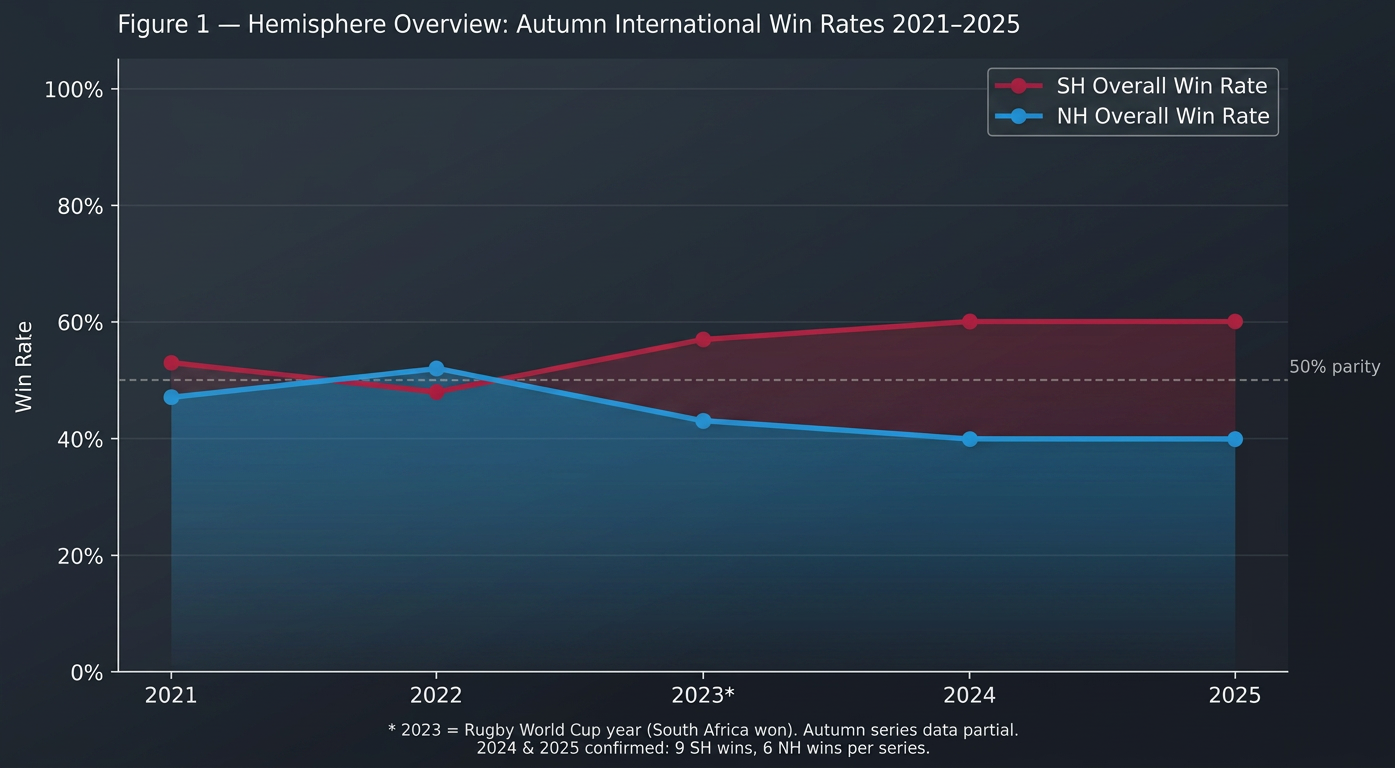
Figure 1. Autumn International Win Rates 2021–2025: Southern vs Northern Hemisphere. 2024 and 2025 confirmed at 9–6 SH. * 2023 = Rugby World Cup year.
A cross-hemisphere win rate analysis from 2021 to 2025 highlights three concurrent trends (see Figure 1). Firstly, South Africa’s success rate in cross-hemisphere test matches has been rising, culminating in near-complete dominance in the autumn series of 2024. Secondly, Australia’s win rate has sharply declined: it was inconsistent yet competitive in 2021, but by 2025 in Europe, it had recorded no wins. Thirdly, New Zealand finds itself in a troubling middle ground: still capable of exceptional performances but no longer the consistently dominant team it once was in cross-hemisphere competitions.
Within the Northern Hemisphere, France and Ireland have improved their performance throughout this period, whereas England has declined. In the 2024 test matches, France achieved three straight wins over New Zealand, a feat that would have been unimaginable ten years ago. Meanwhile, Ireland defeated South Africa 2-1 during their 2024 mid-year tour, demonstrating they are serious contenders regardless of the location.
In contrast, England has fallen from a team that narrowly beat South Africa in 2021 to one that now struggles to maintain that level of competitiveness. The talent pool remains strong, and coaching
The Connection Thesis: Why This Is Not About Geography
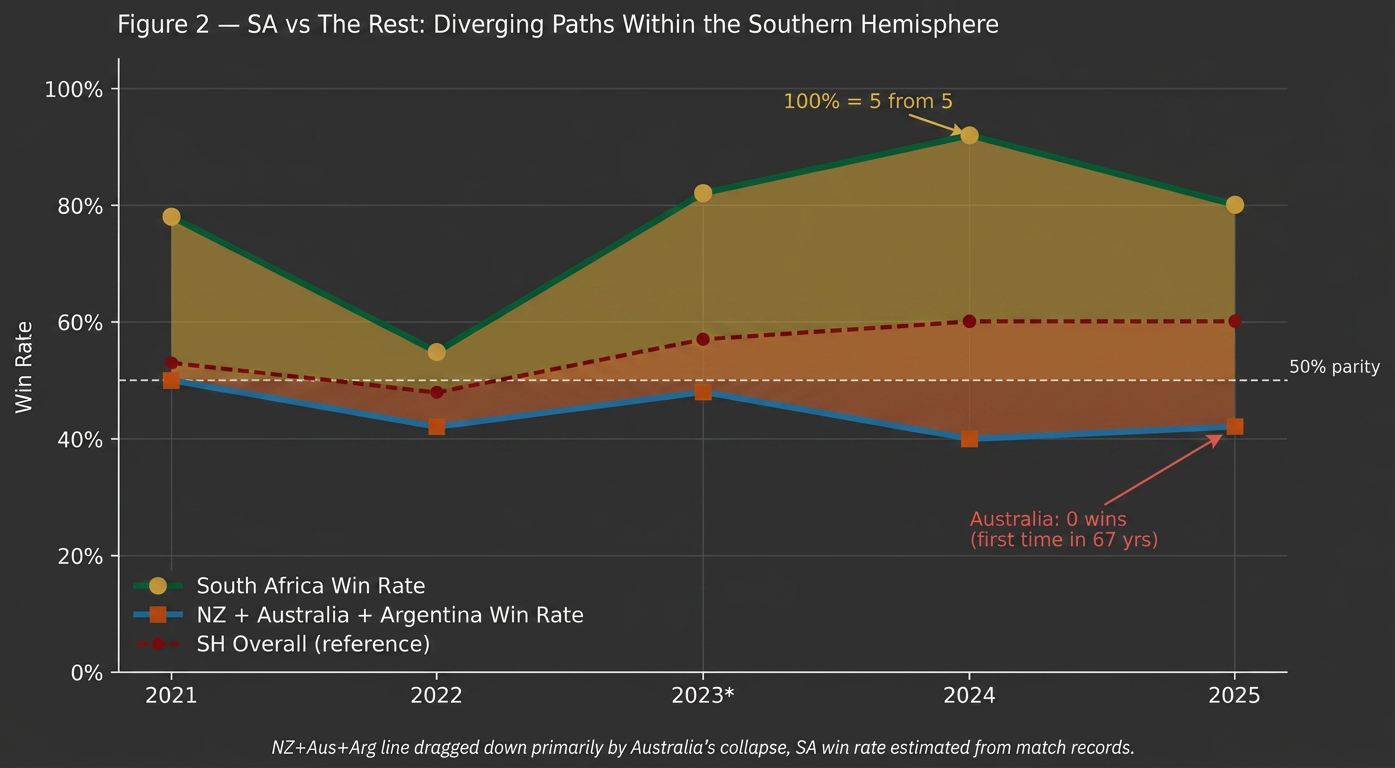
Figure 2. SA vs The Rest: Diverging Paths Within the Southern Hemisphere. South Africa’s near-100% win rate in the 2024 autumn contrasts sharply with Australia’s complete collapse in 2025.
This article introduces the Connection Index, a framework I developed during coaching, to quantify the extent to which community and provincial identities are ingrained in a nation’s rugby culture. It is inspired by the principles popularised by Billy Beane’s Moneyball approach with the Oakland Athletics (Lewis, 2003), which emphasise that commonly measured statistics are not necessarily the best predictors of performance.
In rugby, common factors like squad depth, player rankings, coaching quality, and competition format are recognised as influential variables with tangible effects. However, these do not fully account for why South Africa’s Springboks, despite navigating similar challenges such as URC travel, player management, and salary cap issues as other major rugby nations, consistently outperform these pressures. Similarly, France, once seen as perennial underachievers despite their talent, has recently emerged as the most reliable team in the NH.
In both cases, the answer lies in provincial identity. The Currie Cup, established in 1891 after Sir Donald Currie’s challenge in 1889, is 135 years old. When a Loftus Versfeld player plays for the Bulls or a Newlands player for the Stormers, they are not merely representing a franchise; they symbolise a community with a rugby heritage that predates most living memory. This isn’t nostalgia; it’s the foundation of psychological infrastructure. Players come to Springbok camp already feeling connected to something bigger. The national jersey builds on that foundation, rather than creating it.
France’s Top 14 operates similarly. Toulouse is more than a successful team; it embodies an identity. Clermont’s supporters form a community that sees rugby as a core part of its culture. When players like Dupont, Ntamack, or Danty wear the French jersey, they carry with them that deep provincial grounding. This foundation manifests as calmness under pressure, a readiness to prioritise the team’s success over personal glory, and the capacity to maintain high intensity for the entire 80 minutes.
England and Australia are the counterexamples. The English Premiership is a commercial league with significant player movement between clubs, driven substantially by salary rather than community allegiance. Australia’s Super Rugby competition has been restructured multiple times in a decade; the Rebels have come and gone, conferences have been added and removed, and the domestic fan base has never fully rebuilt the tribal loyalty that emotionally sustains players. When those players put on the Wallabies jersey, they are starting from scratch in terms of identity.
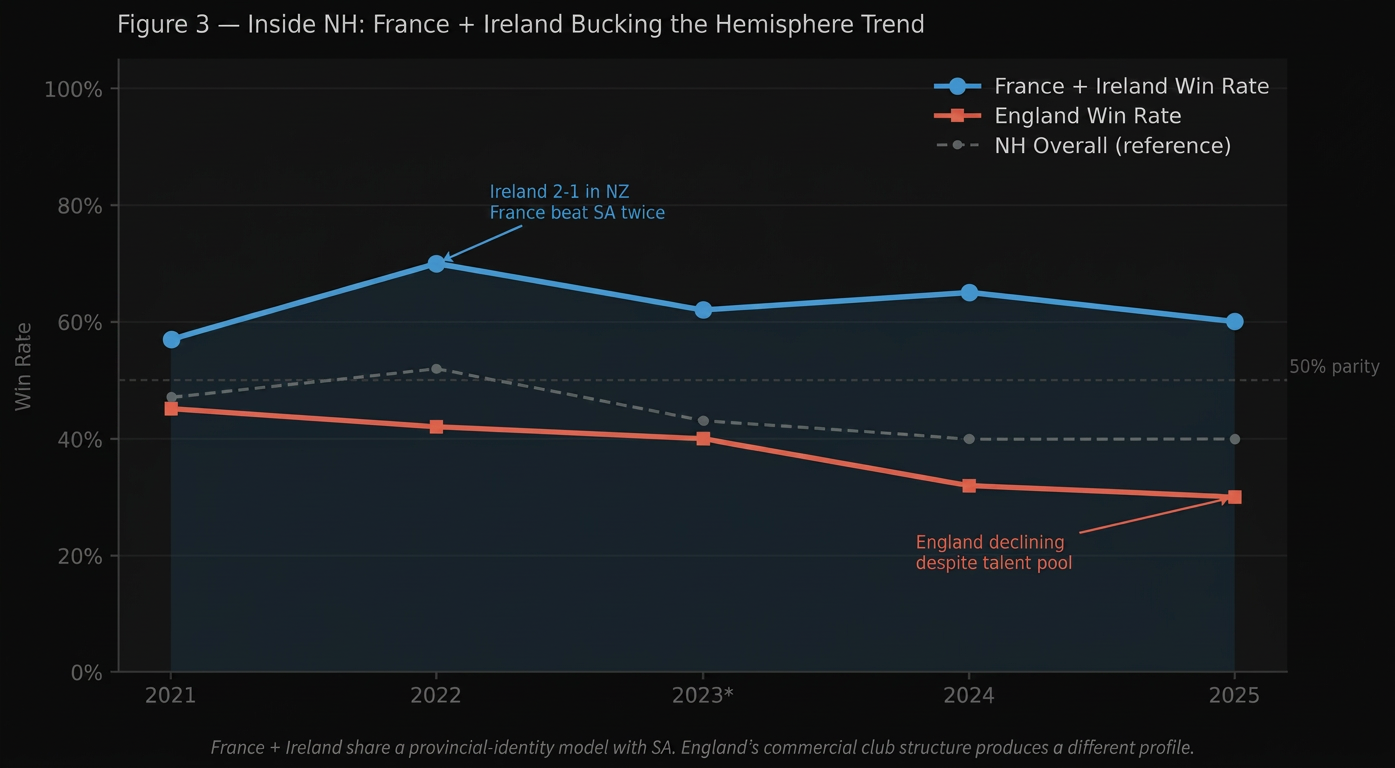
Figure 3. Inside the Northern Hemisphere: France + Ireland Consistently Outperform the NH Average. England’s declining win rate, despite a strong talent pool, reflects structural disconnection in club rugby.
SA Franchise Landscape: Where the 2026/27 Season’s Foundations Lie
An honest evaluation of the 2026/27 URC season, starting in September 2026, must begin with the current status of the four South African franchises, which have become key figures in European club rugby. The 2024-25 season highlighted four distinct narratives, shaping the expectations and challenges for each franchise in this upcoming campaign.
The Stormers continue to set the standard, finishing third in the 2024-25 URC playoffs. They exemplify the strongest integration of an SA franchise into the European competition format. Under John Dobson’s leadership, the team has cultivated a culture that reflects provincial pride, featuring players such as Sacha Feinberg-Mngomezulu, Evan Roos, Cobus Reinach, Damian Willemse, Wandisile Simelane, the return of Siya Kolisi, and the upcoming Springbok Paul De Villers. More than just a skilled group, they have a clear identity. By September 2026, they will be the best-positioned SA franchise to compete for European titles.
The Bulls finished fourth and reached the URC final, a notable achievement that highlights their ability to rotate players and manage squad depth amid a challenging schedule of URC and European matches. Their 14 wins and 7 losses in the regular season kept them in the top tier. The Bulls are still the most physically aggressive of the SA franchises, with a forward pack and kicking game that are better suited to European winter conditions than any other South African team.
The Lions’ 2024-25 season marked a significant milestone. Finishing seventh, they qualified for their first URC playoff, an achievement deserving recognition. Historically known for entertaining, running rugby in the old Super Rugby days, their qualification in a more physically demanding and tactically cautious league indicates a major structural change. The main question for 2026/27 is whether they can sustain and build on this progress or if maintaining momentum will be more difficult than their initial breakthrough.
The Sharks struggled in 2024-25, finishing tenth and losing most of their matches in the European campaign. The Sharks highlight the challenges posed by travel, squad depth, and scheduling pressure for SA franchises. The 2026/27 season begins with the Sharks needing to resolve that structural issue rather than simply outrun it with individual talent.
The European Stage: Top 14 and Champions Cup for 2026/27
The Top 14 starts the 2026/27 season in a compelling structural state. French club rugby has become the world’s most lucrative competition in terms of average player salaries, and the standard of play has advanced to reflect these financial gains. However, the most notable change isn’t the financial aspect but the transformation in coaching philosophy that has come with it.
The leading French clubs have adopted a hybrid approach combining possession and territorial control. They utilise accurate kicking to dominate territory while preserving the ball-in-hand flair characteristic of French rugby. This isn’t a replica of the Springbok style but a uniquely French version of controlled aggression, developed by technical teams integrating NH precision with SH physicality into a unified system. By September 2026, the Top 14 is likely to deliver the most technically advanced club rugby globally.
The European Champions Cup is the ultimate measure of cross-competition ability. SA franchises in this tournament face a unique challenge: after travelling from South Africa to Europe for URC matches, they must also handle the logistical and physical demands of knockout rugby on home turf. The Stormers and Bulls have demonstrated they can manage this. The Sharks and Lions must develop similar resilience if they aim to become regular Champions Cup contenders rather than just occasional competitors.
The Southern Finishers: Currie Cup, NPC, and Australian Rugby
The Currie Cup, concluding another season, warrants special recognition due to its long history. Established in 1891 as a response to Sir Donald Currie’s 1889 challenge, it has been active for over 135 years, making it one of the world’s oldest continuous domestic rugby competitions. Meanwhile, New Zealand’s NPC (initially formed in 1976, though provincial rugby there dates back to the 1870s) is now approaching its 50th year of formal competition. Both tournaments serve more than just crowning a champion; they are foundational communities where the Connection Index is developed, season by season. When Currie Cup rugby is played at high intensity between Sharks and Lions, or Bulls and Stormers, those are not meaningless fixtures. Those are the furnaces in which international players are forged with provincial fire. The argument for protecting the Currie Cup from being subsumed entirely by URC scheduling requirements is precisely the Connection argument. Reduce the Currie Cup, and you reduce the feedstock that makes Springbok rugby exceptional. As URC and Champions Cup demands intensify in 2026/27, this tension will sharpen.
New Zealand encounters a similar challenge with the NPC, worsened by the fact that its leading players are now signing lucrative contracts in France, Japan, and the UK. This trend diminishes the pool of talent available for the provincial level, leading to a noticeable decline in depth. While New Zealand remains one of the top three rugby nations globally, its level of dominance has significantly decreased compared to a decade ago.
Australian rugby faces a key challenge: rebuilding community identity around a professional sport lacking the provincial depth seen in SA or NZ. The Brumbies, with their new partnership with Gallagher insurance starting in 2026, exemplify Australia’s most professional franchise. However, a single well-managed team cannot fill the systemic gaps. For genuine recovery, Australian rugby needs a sustained focus on grassroots community engagement, beyond quick fixes like coaching changes or competition reforms.
Coaching Trends: The Technical Fingerprint of 2026/27
As the 2026/27 season approaches, the key coaching trend is the merging of kicking and running game philosophies at the elite level. The traditional division between kick-territory teams and ball-in-hand teams has faded. Top coaches now develop systems that utilise the kick as a weapon in attack, rather than just for territory gain, while maintaining a structure to capitalise on opportunities from contestable kicks.
South Africa has pioneered this trend. The Springbok kicking game isn’t purely defensive; it represents strategic aggression via the air. Their chasers are athletes, not merely ball collectors. When Cheslin Kolbe or Kurt-Lee Arendse pursue a kick, they take on a technically demanding attacking role that requires high-level spatial awareness, timing, and bravery. The tactical ingenuity behind this system warrants more recognition than it often gets. France has tailored this approach to their context: utilising wider channels, faster defensive line speed, and a kicking strategy that leverages physical mismatches, front-foot forwards versus outside backs in the air. Ireland, maintaining their disciplined provincial system, has focused more on kick-pass sequences, using the aerial ball as the final pass rather than just territory gain. A key coaching challenge in 2026/27 is how Northern Hemisphere teams will adapt their line-speed and aerial challenge strategies to match the physicality of SA franchises in the URC. Success in this area will position those teams for European success in May 2027.
The Moneyball Thesis: Measuring What Actually Matters
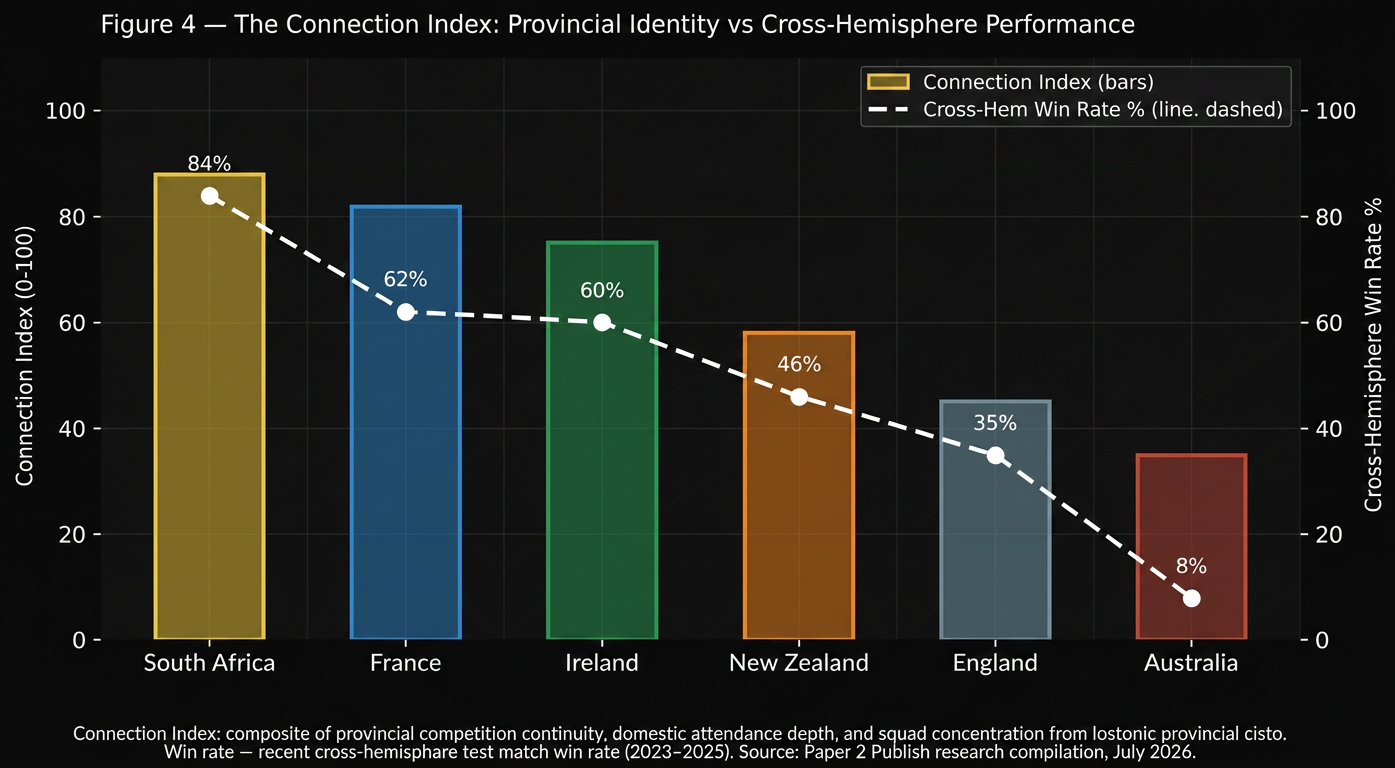
Figure 4. The Connection Index: Provincial Identity vs Cross-Hemisphere Win Rate 2023–2025. High community- and provincial-level embeddedness correlates strongly with sustained cross-hemisphere performance. SA (88) and France (82) lead both metrics; Australia (35) and England (45) sit at the bottom of both.
Billy Beane’s insight into baseball was that statistics weren’t unimportant, but that everyone was focused on the wrong ones. On-base percentage predicts wins more accurately than batting average, yet the market hasn’t recognised this. Teams that understood this could assemble competitive rosters at a lower cost. Rugby has its own version of this inefficiency. The metrics often debated, tackle completion rate, meters gained, lineout retention, and ruck speed, are real and significant. However, they measure individual and unit execution within a game, not the extent to which a team functions as a true collective. What is rarely measured consistently is the Connection Index in all its forms: the psychological cohesion that comes from a shared provincial identity, the sustained motivation that comes from playing for a community rather than a paycheck, and the composure under pressure that comes from not needing to prove your identity upon arriving at an international tournament.
South Africa’s coaching and selection system implicitly understands and optimises for this. So does Ireland’s provincial model. And increasingly, so does France’s Top 14 club culture. The teams and nations that are winning consistently, the ones whose results have improved over this analysis period, while others have declined, share this characteristic. The ones that are struggling (England, Australia) are the ones whose competition structures most undermine it.
This is not an argument against player movement, salary caps, or the commercial realities of professional rugby. It is argued that the sport needs to develop measurement tools that capture the quality of team connection, not just individual skill. A team of 10-out-of-10 individual performers who do not genuinely belong to each other will lose to a team of 8-out-of-10 performers who do. We have seen enough examples of this in the last four years to stop treating it as an anomaly and start treating it as a law.
Looking Ahead to September 2026
The 2026/27 rugby season begins with a clearer structure than previous years. The teams competing for major titles in the URC, Top 14, Champions Cup, and the 2027 Rugby World Cup will be those that have addressed their core connection issues. Success will no longer depend solely on large budgets or star players but on teams that have cultivated a strong communal identity through their jerseys. In South Africa, the focus is on safeguarding provincial structures that foster this identity while managing the logistics of a busy international calendar. New Zealand seeks to curb the talent drain and reignite provincial passion amid a more dispersed professional landscape. Australia’s challenge is the most demanding: to develop a robust grassroots culture that makes the Wallabies jersey feel like an evolving tradition rather than a blank slate.
For France and Ireland, the immediate challenge is to turn their strategic advantages into consistent tournament success and translate their reliable test performance into positive results at the World Cup, where different pressures and conditions come into play. For England, talent and coaching infrastructure are present; what’s lacking is a club-level sense of community that nurtures international players from within their local roots. Until the Premiership manages to rebuild this provincial identity, England will remain a collection of talented individuals rather than a cohesive team. The game constantly teaches us lessons, which is why we discuss it. The differences observed in hemisphere data are not warnings about geography but lessons about the core foundations of rugby, which, at its best, are rooted in community. As September 2026 approaches and a new season begins across both hemispheres, this lesson continues to unfold in the results.
References
Beane, B., Depodesta, P., & Alderson, S. (cited in Lewis, M., 2003). Moneyball: The art of winning an unfair game. W. W. Norton & Company.
Bowles, J. (2025). Rugby’s ongoing evolution: Reflections from the final quarter of 2025. Paper 2 Publish.
Lewis, M. (2003). Moneyball: The art of winning an unfair game. W. W. Norton & Company.
New Zealand Rugby. (2026). NPC competition overview and historical records. Retrieved from https://www.nzrugby.co.nz
Rugby Union Statistics. (2025). Autumn internationals 2024: Match results and analysis. Retrieved from https://www.rugbypass.com
Rugby Union Statistics. (2026). Autumn internationals 2025: Match results and analysis. Retrieved from https://www.rugbypass.com
SA Rugby. (2026). Currie Cup historical records. Retrieved from https://sarugby.co.za
Tee, J. C., Ashford, M., & Piggott, D. (2018). A tactical periodization approach for rugby union. Strength and Conditioning Journal, 40(5), 1–13. https://doi.org/10.1519/SSC.0000000000000390
United Rugby Championship. (2026). 2024-25 season standings and results. Retrieved from https://www.unitedrugby.com
World Rugby. (2026). Laws of the game: Rugby union. World Rugby Limited. https://laws.worldrugby.org



Leave a Reply